My article “Handbook, Database, Cloud: Regimes of Observation and the Infrastructural Making of Universities” has been accepted for publication in the European Journal of Sociology. As I am preparing the final version, I thought this would be a good opportunity to walk through the main argument here and explain why I think it matters.
How do we know which universities exist in the world, and what they are like?
There is a long tradition of asking what rankings, indicators, and other numbers do to universities. Much less attention, however, has gone to what makes this knowledge possible in the first place. For universities to be known and compared worldwide, someone has to observe them, describe them, classify them, and not least keep doing so. This takes technologies, but also people and organizations willing to coordinate around them. These, however, change over time, and with them, so does the way we see universities.
In the paper, I trace how this has worked over more than a hundred years. The research draws on some nine thousand pages from the uncatalogued archive of the International Association of Universities (IAU) in Paris, a wide range of documents, from handbooks to product literature and licensing agreements, and nineteen interviews with people who built, studied, or used these infrastructures.
Regimes of observation
The central concept is what I call a regime of observation. It brings together three things: a technology that makes certain things visible and recordable, with its affordances; an abstraction of what a university is, which takes shape through the use of specific technology; and the people and organizations that establish, contest, and maintain the arrangement.
I identify three such regimes, each associated with a different technology, or family of technologies: the handbook, the database, and the coupled-based platform.
Seeing like a handbook: the recognitive regime
From the late nineteenth century onwards, information about universities circulated through printed handbooks. Between 1959 and the mid-1970s, the Association of Commonwealth Universities, the American Council on Education, and the IAU coordinated their handbooks into the first worldwide reference series produced by universities, through their representative bodies. Each entry offered a compact account of a particular higher education institution, written in prose. You consulted it rather than reading it from cover to cover. Like you’d consult an encyclopedia.
Although the handbooks differed in their criteria for inclusion, they all drew a line between institutions that counted as universities (or higher education institutions, more broadly) and those that did not. In doing so, they reduced a complex landscape of national laws and institutional arrangements to a simple distinction: recognized or not. In this sense, the main question this regime asks is: Is X or Y a recognized university? Hence, the recognitive regime.
Seeing like a database: the commensurative regime
The second way of seeing universities takes shape around the database.
Unlike a handbook, a database does not describe a university in prose. Instead, it breaks it down into standardized attributes, such as student numbers, staff, expenditure, and publications, which can be aggregated, queried, and compared. The question it asks thus changes accordingly: What kind of university is this, seen through standardized variables, and how does it compare to others? I call this the commensurative regime.
In the paper, I argue in the paper that the regime works best where there is a legal mandate, as in the United States, for example. Internationally, however, building comparable databases has proved much harder. When the IAU coordinated an effort to build a shared international database in the late 1980s and early 1990s, some national partners objected that the proposed classification did not fit their systems. Without a common framework—or the authority to impose one—making university data comparable across countries becomes an uphill struggle.
Then, in the early 2000s, global rankings arrived. These rankings, however, did not need to build a new infrastructure to compare universities on a large scale. Instead, they drew on existing bibliometric databases, developed for libraries and already widely used for decades, aggregating publication data at the level of the university. In doing so, they turned infrastructures built primarily for finding and organizing scholarly literature into sources of information about universities for policymakers and university administrators around the world. This turned out to be a consequential shift: universities themselves became objects of comparison through infrastructures originally built for a different purpose.
Seeing like a cloud: the extractivist regime
The companies behind major bibliometric databases saw an opportunity. But it took more than a decade for them to become the business we know today, and depended on technological developments along the way. Scopus and Web of Science gradually evolved from search tools for researchers and librarians into the data backbone of a growing range of products, from research analytics and benchmarking services to the data supply for influential rankings. SciVal, InCites, and Pure are just a few examples of platforms built around this kind of infrastructure.
The companies behind these databases saw an opportunity. But it took more than a decade for them to become the businesses we know today—a transformation that went hand in hand with technological developments. Scopus and Web of Science gradually evolved from search tools for researchers and librarians into the data backbone of a growing range of products, from research analytics and benchmarking services to the data supply for influential rankings. SciVal, InCites, and Pure are just a few examples of platforms built around this kind of infrastructure.
In this regime, which I call extractivist (borrowing the term by analogy from political ecology), the university becomes an aggregation node in a proprietary ecosystem. The questions from the other two regimes remain: Is this a legitimate university, and how does it compare to others? But the platform owner asks another question, too: What can this university yield, both as a source of data and as a customer? The university cannot fully see how that question is answered.
More consequentially, a university does not have to decide to join this ecosystem. If its researchers publish in journals indexed by commercial databases, their publications become part of the data these companies collect and use. In this sense, the extractivist regime operates not so much behind universities’ backs as largely without their consent.
One thing on top of another
The three regimes, even though they emerged at different times, are not to be understood as phases—which is one of the main arguments of the paper. They do not replace one another, but sediment, or accumulate, whereby earlier arrangements alongside newer ones and help shape how they work.
Take Scopus. For a university to be compared through its publications, it first has to be included in the database. This is already a form of recognition, based on the database’s own criteria. Once included, its publications can be aggregated and compared. And because Scopus is part of Elsevier’s ecosystem, the data can also be used for commercial products and services.
Rankings illustrate this particularly well. We tend to study them as instruments of comparison, which they certainly are. But they also determine which universities are eligible to be ranked in the first place, and draw on data that can be used for commercial purposes beyond the rankings themselves. In this sense, rankings bring together all three regimes: recognition, comparison, and extraction.
While it might be tempting to conclude that technologies determine what we see and are the ones to cause or drive specific regimes, this is not so. I treat technologies as enablers rather than causes (following Abend’s argument). The printing press did not produce the handbook, nor did the computer produce the database. Each became part of a regime only through specific forms of institutionalization, ownership, and use.
Why this matters
What changes across these regimes is not whether there is coordination, but how visible its terms are to the universities being observed. Universities could at least partly inspect and contest the criteria used in handbooks or public databases. With commercial platforms, this is much harder. The parameters are often undisclosed, and what a university can see of its own position depends on the licences and services it pays for.
Research on higher education and its governance, however, remains largely focused on the commensurative question. What goes into the score? Did the score change? Did behavior change as a result? These are all fair questions. But they leave aside how growing reliance on the infrastructures behind those scores has reshaped power relations in the field. And by keeping our attention there, we risk overlooking precisely the power of the organizations that own and control these infrastructures.
The paper also speaks to several scholarly debates:
Organizational sociology has long shown how organizations converge on legitimate forms under external scrutiny. But it tends to pay less attention to the technologies through which that scrutiny takes place. My argument brings these technologies into the picture, showing how observation itself helps shape organizations.
Science and technology studies, in turn, has shown how classification systems and platforms shape what can be counted and compared. Rather than examining one infrastructure at a time, this paper traces how several infrastructures accumulate and interact over time.
Finally, the sociology of quantification has called for more attention to how different systems of quantification interact. The concept of regimes of observation offers one way to study these interactions—not simply by classifying different measurement tools, but by tracing how objects such as rankings bring several regimes together, and what this means for the universities caught up in them.
Looking at how these regimes interact helps us understand not just how universities are compared, but who gets to define what counts, what can be seen, and what can be done with the resulting data.
There’s much more to the story, of course, and the paper goes into considerably more detail. For now, back to finalizing it. I’ll share the published version here as soon as it’s out.
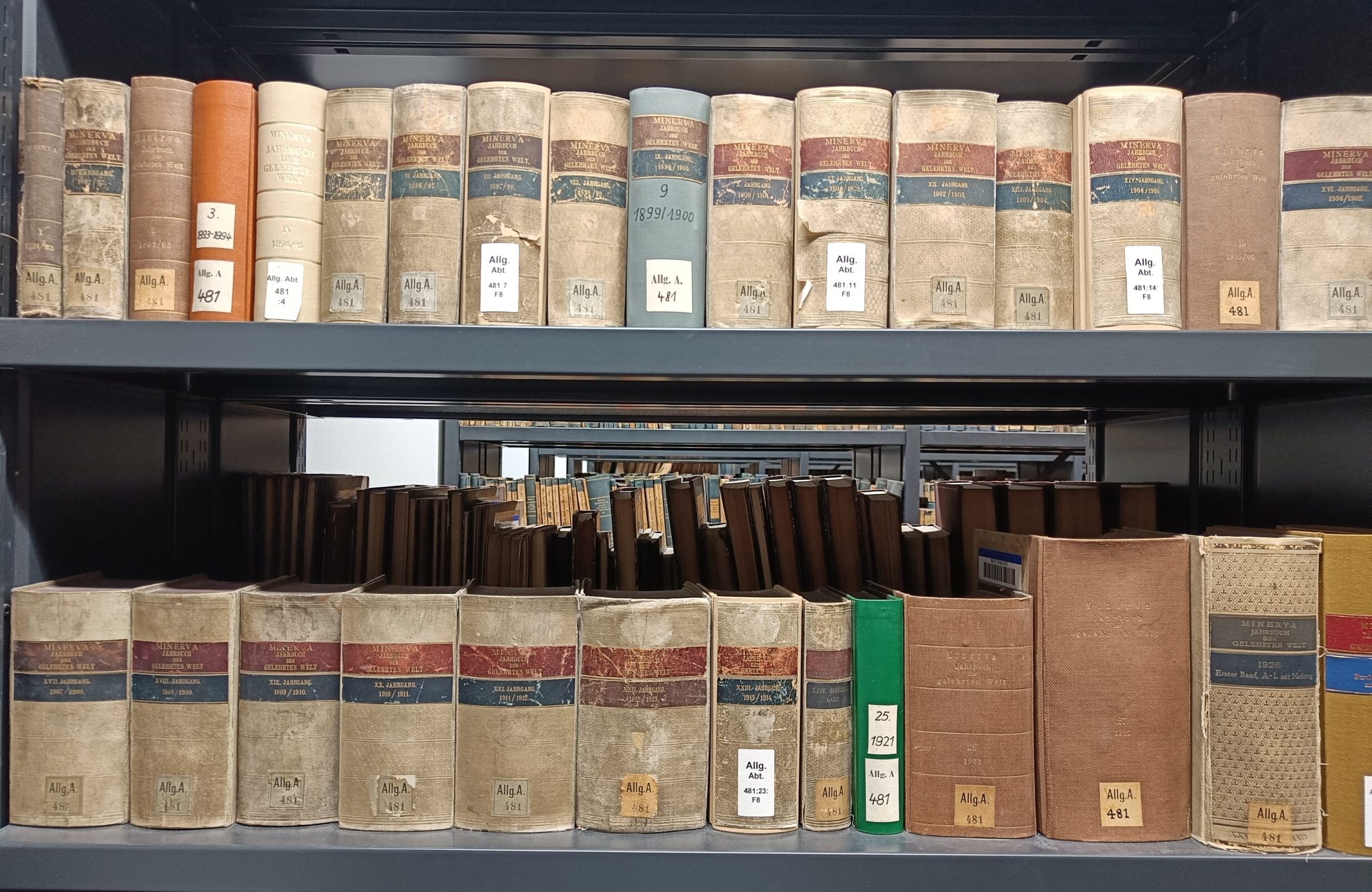
Photo: First editions of Minerva: Jahrbuch der gelehrten Welt, a German yearbook of the world’s universities, academies, and learned societies. Humboldt University Library, Berlin. © Jelena Brankovic.